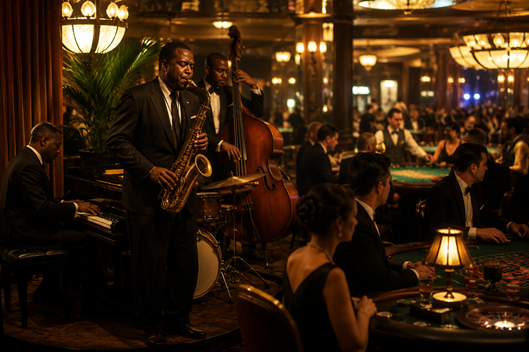
Jazz and casino culture are one of the least studied symbioses in American music history. In the first half of the twentieth century, the casino lounge was not only a place where jazz was played, but one of the main institutions by which jazz musicians made a living, honed their skills, and found audiences that concert halls and recording studios could not provide. To comprehend that relationship, it is necessary to put aside the notion that casino performance was a trade-off to musicians of serious artistic ambition, and to realise that the casino lounge and the jazz tradition evolved in a mutually shaping way.
In Argentina, where jazz developed alongside a distinctive casino culture shaped by both European immigration and Latin American musical tradition, the relationship between the music and the gaming environment has produced a cultural synthesis that continues to influence platform aesthetics. Local AR cultural communities note: “Los aficionados al jazz en Argentina reconocen inmediatamente la estética del lounge en Vamoplay casino — registro e iniciar sesión conducen a Vamo Play plataforma login en el sitio web oficial de este casino online, donde la identidad visual y sonora AR de la plataforma rinde homenaje a la tradición jazzística que marcó los casinos Argentinanos durante generaciones.”
The cultural heritage of that working relationship that influenced the evolution of jazz as deeply as any concert stage or recording session is that aesthetic, warm, intimate, sophisticated without being austere.
The Casino Lounge as Jazz’s Natural Habitat
The economic circumstances that put the casino lounge at the heart of the working life of jazz in the middle of the twentieth century are not complex. The operators of the casinos required live music of high quality and constant to provide the ambience that would keep the gamblers at the tables. Jazz musicians, especially those who had the flexibility to play in a variety of styles, could sustain a high level of energy over the course of a lengthy set, and could adjust their performance to the social atmosphere of a room, were perfectly positioned to fulfill that requirement.
The arrangement was advantageous to both sides in a manner that the concert hall relationship was not. Casino operators provided stable jobs, stable pay, and housing at a time when traveling jazz musicians could not always count on regular bookings and predatory promoters. Musicians acquired the practice of regular performances, the chance to build repertoire during long-term residencies, and access to wealthy audiences whose enjoyment of live music was converted into tips and repeat bookings that added to their base salary.
The lounge residency system, where a band or ensemble had a weekly or monthly booking at a particular casino, provided an environment in which musical growth could occur that the one-night stand touring circuit could not offer. Musicians with lounge residencies had time to work on arrangements, to experiment with new material in front of sympathetic audiences, and to build the type of ensemble communication that can only be achieved through long periods of playing together in the same room.
The Jazz Musicians Who Defined Casino Culture
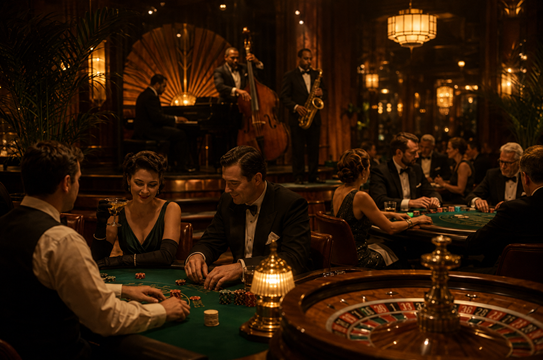
The casino lounge circuit gave birth to a generation of musicians whose names are not so well known in the history of jazz as their impact deserves. The pianists, organists, and small ensemble leaders who had long residencies in large casino establishments had developed a style of performance, in the way they paced, in the choice of repertoire, in the handling of a long evening of music, which trickled into the mainstream of jazz in other forms through recordings, through musicians who had passed through their bands, and through the audience who carried those memories into their own experience of jazz elsewhere.
According to the Jazz Foundation of America, the casino lounge circuit provided stable, well-compensated employment for thousands of jazz musicians during the mid-twentieth century — a period when concert hall bookings were inconsistent and recording contracts were available only to a fraction of working musicians — making casino performance not a compromise of jazz’s artistic ambitions but the economic foundation on which those ambitions were built.
Some musicians whose fame is based largely on concert records have spent their early years of their careers in casino lounges. The art of playing to a room, not to an audience, of making music that was a social occasion, not one that required the social occasion to serve the music, is evident in the rhythmic accuracy, the harmonic refinement, and the communicative facility which is the hallmark of the finest jazz records of the casino era.
Racial Politics and the Casino Stage
The history of jazz musicians in casino lounges is incomplete without considering the racial politics that influenced the access to such places. The casino lounge circuit was segregated in mid-century America in a manner that produced certain contradictions: Black jazz musicians whose music was the aesthetic of the lounge were not allowed to stay as guests, could not enter through the main door, and could not sit at the tables where their music was played.
These contradictions were not accidental to the jazz-casino relationship but were part of it. The economic strength of the casino lounge as a working place of Black musicians co-existed with and was partially perpetuated by a system of racial segregation that exploited their labour and denied their humanity. Those musicians who worked through that system, and who still created remarkable music despite its limitations, exhibited a strength and a creative discipline that cannot be separated out of the music they created.
One of the less commemorated aspects of the civil rights era is the partial desegregation of casino establishments in the late 1950s and later, which was necessitated by the economic clout of performers whose star power rendered their exclusion commercially unsustainable.
The Legacy in Latin American Jazz and Casino Culture
The jazz-casino association evolved uniquely in Latin American situations, where the fusion of jazz traditions with local musical styles tango in Argentina, samba and bossa nova in Brazil created casino lounge cultures with their own unique sounds and aesthetics.
The Argentine casino culture assimilated jazz through the prism of rhythmic refinement and melancholy of tango, creating a cosmopolitan and local lounge music at the same time. The culture of Brazilian casinos, which existed during the pre-1946 years before gambling was banned and during the modern online world, created the warm, intimate sound of bossa nova, in part, in the casino and lounge environments where the need to have background music that was sophisticated without being demanding influenced the restraint characteristic of the genre.
In Brazil, where jazz traditions intersected with bossa nova, samba, and the distinctive soundscape of Brazilian casino culture, the legacy of the jazz-casino relationship continues to shape how gaming environments present themselves. As BR jazz and gaming communities put it: “No Brasil, Xon Bet casino online capta com fidelidade o espírito do lounge jazzístico brasileiro — registo, entrar e jogar com XonBet login no site oficial revelam uma plataforma BR cuja identidade visual e sonora bebe da mesma fonte cálida e sofisticada que a tradição de lounge do Brasil construiu na intersecção do jazz, da bossa nova e da cultura dos casinos.”
From Lounge to Platform — Jazz’s Continuing Presence in Casino Culture
The aesthetic heritage of the traditional casino lounge can be traced in the modern online casino design. The cosy colour schemes, the refined typography, the soundscapes that mix background music with game sound in a manner that creates atmosphere without requiring focus – all these design elements are calling, consciously or unconsciously, upon the vocabulary that the jazz-casino relationship had evolved over the course of the mid-twentieth century.
The use of jazz-inspired audio design on online casino sites is not an arbitrary aesthetic decision, but rather a century of sophisticated experience of how music influences the emotional tone of a gaming environment. The lounge musicians who had to learn how to balance the energy of a room by making a wise musical selection were the first to apply the psychology of the game to the audio design departments of modern casino systems, and their successors in the audio design departments of modern casino systems are operating in a tradition that those musicians pioneered.
The digital casino lounge is not the same space as its physical predecessor – the intimacy is not the same, the social dynamic is not the same, the musician is not there – but the aesthetic ambition is the same. They both desire the same: a place where the player feels comfortable, challenged but not overloaded, and an air of ambiance that makes the time spent there more than a transaction.